Norway’s King Harald V Dies at 89 After 35 Years on the Throne
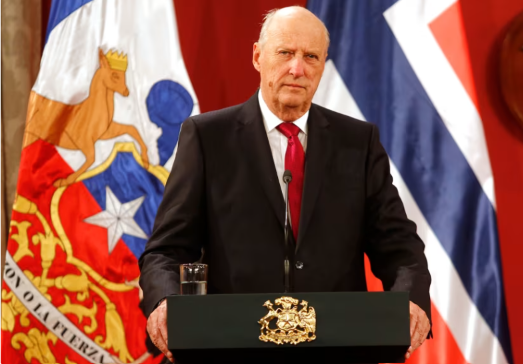
King Harald V of Norway has died at the age of 89, bringing an end to a 35-year reign.
The Royal House of Norway announced that the King died on Friday shortly after 6:35 a.m. His son, Crown Prince Haakon, succeeds him as monarch.
King Harald leaves behind his wife of 57 years, Queen Sonja, their two children and five grandchildren. His granddaughter, Princess Ingrid Alexandra, now becomes heir to the Norwegian throne.
Harald’s death comes as the Norwegian royal family faces a difficult period. Queen Consort Mette-Marit, the wife of King Haakon, has experienced health challenges in recent years and came under international scrutiny this year following revelations about her past contact with convicted sex offender Jeffrey Epstein.
Her son from a previous relationship was also convicted of rape and domestic violence and sentenced to four years in prison.
A Lifetime of Service
Born on February 21, 1937, Harald was the youngest of three children and the only son of then Crown Prince Olav and Princess Märtha.
He was three years old when Nazi Germany invaded Norway in 1940, forcing the royal family to flee. Harald, his mother and two sisters eventually travelled to the United States, while his grandfather, King Haakon VII, and his father remained in London for much of the German occupation.
Harald returned to Norway in June 1945, at the age of eight, following Germany’s surrender. He was welcomed by large crowds in Oslo alongside other members of the royal family.
In keeping with efforts to modernise the monarchy and strengthen its connection with ordinary Norwegians, Harald attended a state school during his early education. He later graduated from Oslo Cathedral School before completing military service at the Norwegian Cavalry Officers’ Training School.
He subsequently studied social sciences, history and economics at the University of Oxford in the United Kingdom.
Harald became King in 1991 at the age of 53, following the death of his father, King Olav V.
At his own request, Harald and Queen Sonja held a consecration ceremony at Nidaros Cathedral in Trondheim on June 23, 1991, incorporating traditions dating back to the Middle Ages.
The “Sailor King”
Harald developed a passion for sailing from an early age and became one of Norway’s most accomplished royal sailors.
The Royal House of Norway estimates that he participated in more than 1,000 regattas and sailing events during his lifetime.
As Crown Prince, he represented Norway in sailing at three Olympic Games — Tokyo in 1964, Mexico City in 1968 and Munich in 1972. He also served as Norway’s flag bearer at the opening ceremony of the 1964 Tokyo Olympics.
His passion for sailing continued throughout his reign, earning him a reputation as the country’s “Sailor King.”
Marriage and Family
Harald’s relationship with Sonja Haraldsen lasted nine years before his father, King Olav V, eventually gave permission for them to marry following consultations with Parliament.
The marriage was significant because Sonja was a commoner. Harald and Sonja eventually married at Oslo Cathedral on August 29, 1968, in a ceremony attended by about 800 guests.
The couple had two children: Princess Märtha Louise, born in 1971, and Prince Haakon, born in 1973.
A constitutional amendment in 1990 changed Norway’s succession rules, allowing the eldest child, regardless of gender, to inherit the throne.
In 2022, Princess Märtha Louise stepped down from her royal duties but retained her title as princess.
A Modernising Monarch
Harald was the first Norwegian-born prince in 567 years.
Norway had previously been ruled by Denmark and Sweden before gaining independence in 1905. Following a referendum, Norwegians chose to retain the monarchy, with Harald’s Danish-born grandfather becoming King Haakon VII.
Harald adopted the same motto as his father and grandfather: “We give our all for Norway.”
Throughout his reign, Harald and Queen Sonja travelled extensively across the country, visiting communities throughout Norway and maintaining a close public presence.
Although the Norwegian monarch’s role is largely ceremonial, the King presides over Council of State meetings and formally opens each new parliamentary session. The monarch also formally approves legislation and government decisions before they are countersigned by the prime minister.
Health Challenges
Harald’s later years were marked by recurring health problems.
He underwent heart surgery twice, including an operation in 2020 to replace a heart valve that had originally been implanted in 2005. During periods when he was incapacitated, Crown Prince Haakon served as regent and carried out official duties on his behalf.
In 2021, Harald underwent surgery to repair a damaged tendon above his right knee and was subsequently seen using crutches.
He was hospitalised with a respiratory infection in 2023 but returned to his official schedule and completed 275 engagements that year.
In 2024, he was hospitalised while on a private holiday in Malaysia after developing an infection and experiencing a low heart rate. A pacemaker was subsequently fitted.
Despite his declining health, Harald remained committed to his constitutional responsibilities.
In January 2024, following Denmark’s Queen Margrethe II’s abdication, Harald dismissed speculation that he might retire, reaffirming his belief that being King was a lifelong responsibility.
“I maintain what I have said all along, I have taken an oath,” he said. “It lasts for life.”
After more than three decades on the Norwegian throne, King Harald V has died, leaving behind a legacy defined by public service, national unity and a close relationship with the Norwegian people.