The new phase: Your questions answered
💬1. What does the “reborn OSP” mean?
It means a new phase, not a new institution.
The OSP was established in 2018 and has spent the years since building a specialised anti-corruption institution — developing investigative and prosecutorial capacity, pursuing asset recovery, undertaking corruption-prevention interventions and establishing the systems required to perform its mandate.
The Supreme Court’s decision has now provided clarity on the constitutional foundation of the Office.
We are not starting again. We are moving forward with greater legal certainty, experience and focus.
💬2. What has the OSP actually done?
The OSP’s work extends across four broad areas:
INVESTIGATIONS
A substantial portfolio of ongoing and completed investigations.
PROSECUTIONS
Ongoing criminal proceedings involving multiple accused persons.
ASSET RECOVERY
Financial recoveries and asset seizures.
PREVENTION
Interventions aimed at identifying and addressing corruption risks before public resources are lost.
An anti-corruption institution should be judged by the totality of its work — investigations, prosecutions, recoveries, disruption of corrupt schemes and prevention.
We do not claim perfection.
The record is public. Examine it, question it and judge it.
💬3. But the OSP has only seven convictions. Where are the results?
The OSP has secured seven convictions through court-approved plea agreements.
However, convictions are not the only measure of an anti-corruption institution’s work. Investigations, asset recovery and corruption-prevention interventions are also part of the statutory mandate.
The objective is not simply to produce numbers. It is to produce sustainable outcomes that withstand scrutiny and the judicial process.
💬4. Does the OSP talk too much?
There is a contradiction in the criticism: when the OSP speaks, some say it talks too much; when we are silent about ongoing investigations, others say we are doing nothing.
The OSP has a statutory and institutional responsibility to keep the public informed about its work, while protecting the integrity of investigations, asset recovery and management, corruption risk assessments and prosecutions.
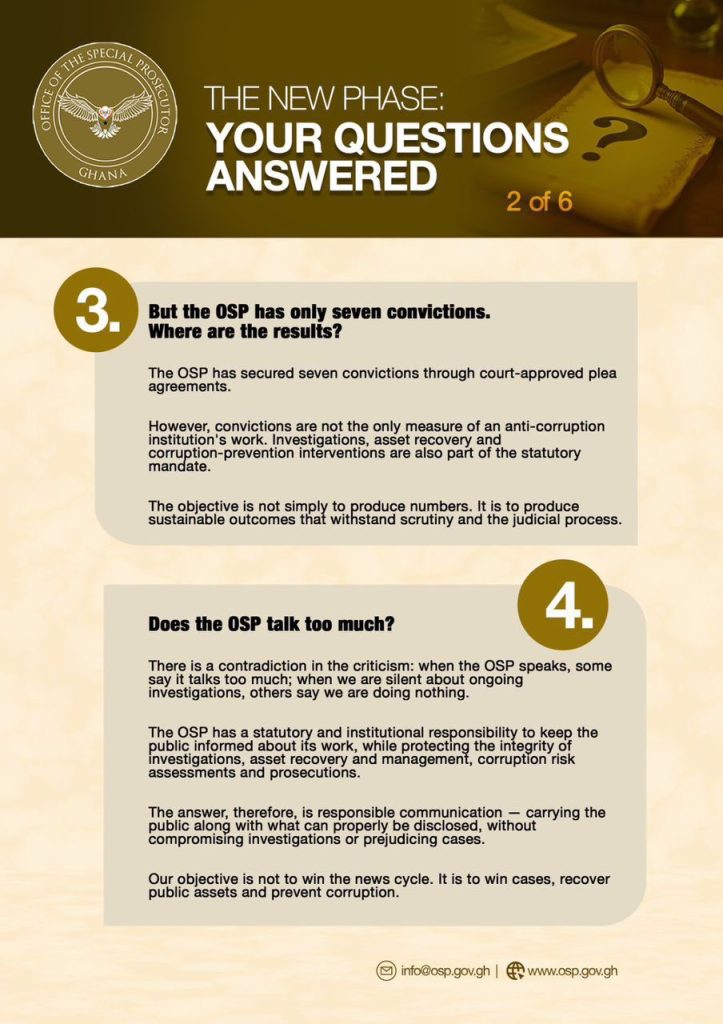
The answer, therefore, is responsible communication — carrying the public along with what can properly be disclosed, without compromising investigations or prejudicing cases.
Our objective is not to win the news cycle. It is to win cases, recover public assets and prevent corruption.
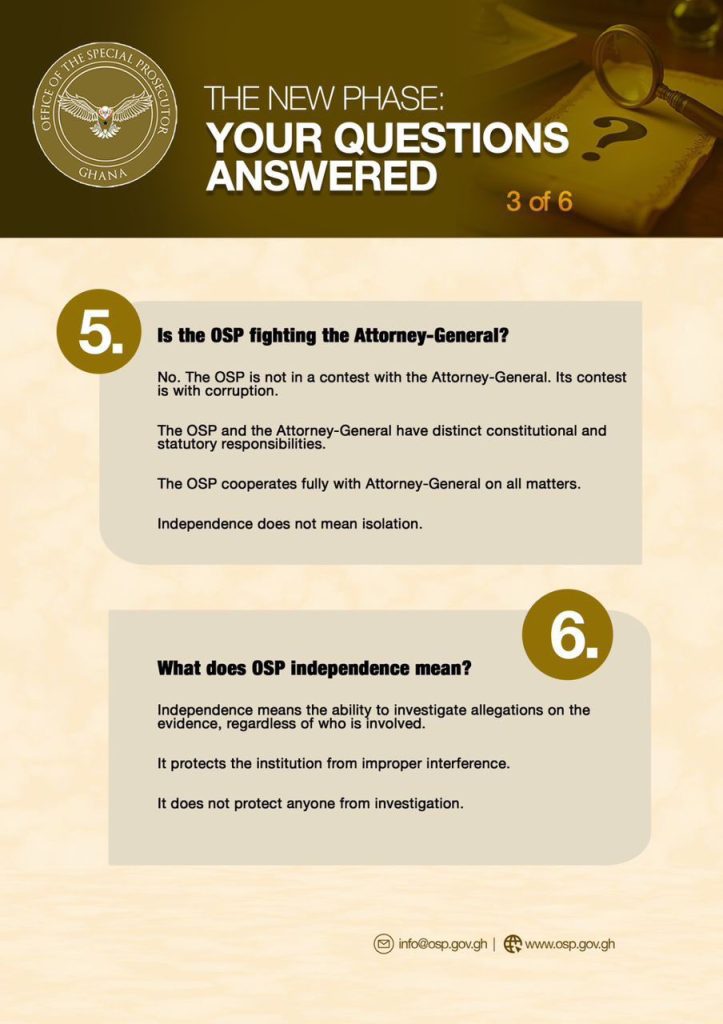
💬5. Is the OSP fighting the Attorney-General?
No. The OSP is not in a contest with the Attorney-General. Its contest is with corruption.
The OSP and the Attorney-General have distinct constitutional and statutory responsibilities.
The OSP cooperates fully with Attorney-General on all matters.
Independence does not mean isolation.
💬6. What does OSP independence mean?
Independence means the ability to investigate allegations on the evidence, regardless of who is involved.
It protects the institution from improper interference.
It does not protect anyone from investigation.
💬7. What does the Supreme Court decision mean?
It provides clarity on the constitutional foundation of the Office and removes the uncertainty created by the constitutional challenge.
But the judgment is not an achievement certificate. It does not investigate a case, prosecute an accused person or recover a cedi.
It gives the OSP the legal certainty to get on with the work.
💬8. What will the OSP do differently?
The new phase will focus on five priorities:
A. FASTER INVESTIGATIONS
Better case management, prioritisation and deployment of resources.
B. STRONGER PROSECUTIONS
Building cases capable of withstanding the full judicial process.
C. GREATER ASSET RECOVERY
Following the money and recovering the proceeds of corruption.
D. STRONGER PREVENTION
Identifying and addressing corruption risks before public money is lost.
E. RESPONSIBLE COMMUNICATION
Keeping the public informed without compromising investigations or cases. The next phase is about execution, efficiency and measurable results.
💬9. Why hasn’t the OSP prosecuted X or Y?
The OSP does not prosecute because of public pressure. It prosecutes where the evidence and the law support prosecution.
The standard is not public suspicion. It is evidence capable of sustaining a case in court.
We would rather build a strong case than rush a weak one.
💬10. Is the OSP ineffective?
The OSP is a relatively young institution, established in 2018, and has had to build specialised investigative, prosecutorial, asset-recovery and prevention capacity while facing significant legal and institutional challenges.
That provides context, not an excuse.
The responsibility now is to convert the capacity that has been built into stronger, faster and measurable results.
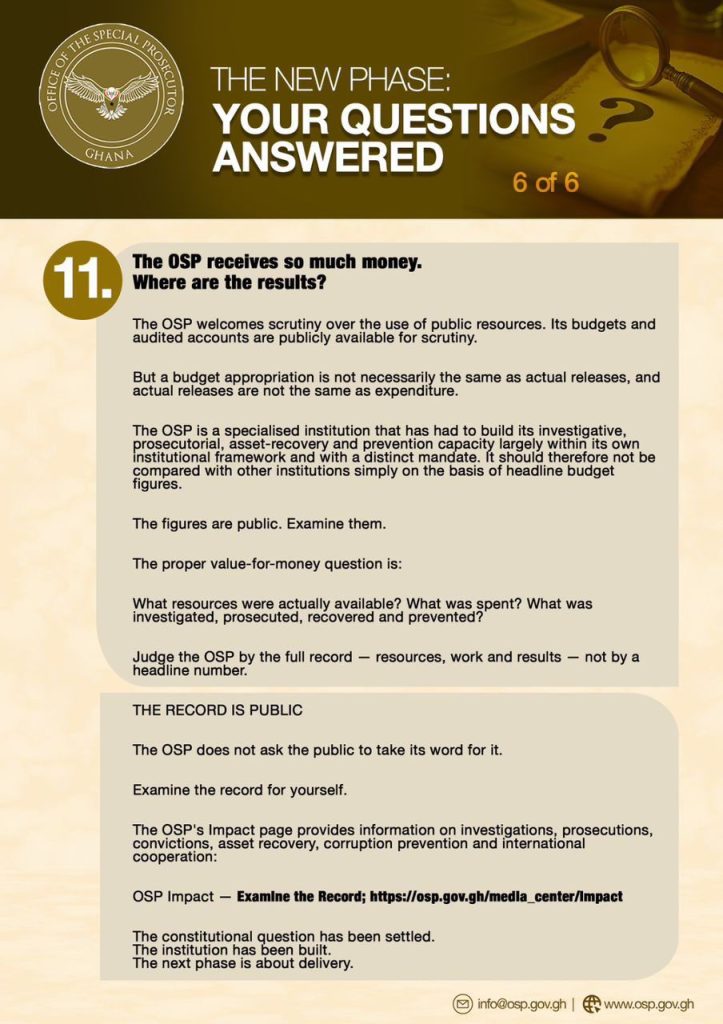
💬11. The OSP receives so much money. Where are the results?
The OSP welcomes scrutiny over the use of public resources. Its budgets and audited accounts are publicly available for scrutiny.
But a budget appropriation is not necessarily the same as actual releases, and actual releases are not the same as expenditure.
The OSP is a specialised institution that has had to build its investigative, prosecutorial, asset-recovery and prevention capacity largely within its own institutional framework and with a distinct mandate. It should therefore not be compared with other institutions simply on the basis of headline budget figures.
The figures are public. Examine them.
The proper value-for-money question is:
What resources were actually available? What was spent? What was investigated, prosecuted, recovered and prevented?
Judge the OSP by the full record — resources, work and results — not by a headline number.
The constitutional question has been settled.
The institution has been built.
The next phase is about delivery.